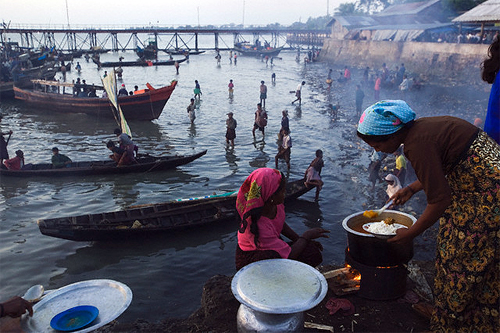
A woman serving mohinga at the port of Sittwe, the capital of Arakan State.
Burmese is an remarkably uniform language, considering it covers a wide area in Burma, or so I thought. Since I could not differentiate Burmese spoken in Mandalay and that spoken in Rangoon (aside from minor vocabulary differences) and instead thought that there is probably a greater difference between the pronunciation of the younger generations and the older ones (I’ve noticed that older people tend to use Bama over Myanma, which is more commonly used among younger people, even in movies) and that younger people are more likely to slur their words.
But I was wrong. According to the UCLA Language Materials Project:
Standard Burmese evolved from a ‘central’ dialect spoken by the Burman population of the lower valleys of the Irrawaddy and Chindwin rivers. It is now spoken with in most of Myanmar with some regional variation. According to Wheatley, there are “a number of non-standard dialects, showing profound differences in pronunciation and vocabulary, are found in peripheral regions”. [Wheatley, 1990] Arakanese, Tavoyan, and Intha can be considered “dialects”, for their distinctive differences in pronunciation and vocabulary from standard Burmese, which does not disrupt a mutual intelligibility with Burmese. Other dialects include Beik, Danu, Taungyo, and Yaw.
I have never been exposed to any other dialects of Burmese other than the standard one. I stumbled upon an Arakanese music video named “La Kran Mray” (“La Chan Myay” in Burmese).
It is so interesting. The Arakanese (more recently called ‘Rakhine’ by the government) are a Tibeto-Burman group that descended from Burmans and moved to the western coastal region of Myanmar, bordering Bangladesh. Because they were geographically isolated by the Arakan Yoma mountain range, they developed a distinct culture and language from the Burmans.
One of the most intriguing things about the Arakanese is their language, particularly its use of the ‘r’ sound, which most Burmese speakers avoid using (they favor ‘y’ or ‘l’ sounds). Because the Burmese language is awfully ambiguous in spelling, standard Burmese does not differentiate between the two ‘y’ consonants in pronunciation (for example, ‘to hear’ and ‘tiger’, both pronounced kya are spelled differently). In Arakanese, they would be kra and kya respectively, which would make spelling so much easier. Another interesting pronunciation difference is in ‘to have’, which is shi in standard Burmese and tschi in Arakanese.
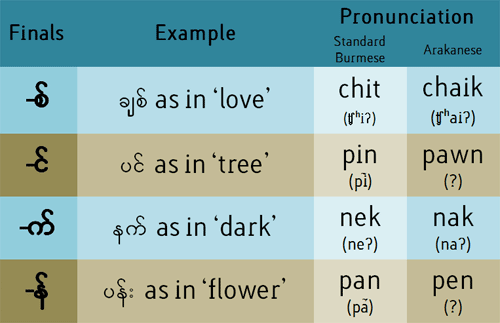
Also, Arakanese pronounces various spellings differently. I don’t know if I’m making sense anymore, but I will continue anyway. Burmese has only two types of finals (sound endings): the nasal ‘n’ (exactly like the ending of ‘bon’ in the French bonjour) and the glottal stop (like the ‘h’ uh-oh). But in spelling, the nasal ‘n’ and the glottal stop can each be spelled four ways. The four main pronunciation differences I noticed in the video between Arakanese and standard Burmese are listed in the following table I made:
Arakanese also uses far more Pali terms than Burmese, as seen in the video. Burmese speakers ought to try understanding the music video. I had to refer to the karaoke subtitles, but it was understandable for the most part.
Another interesting aspect of the Arakanese dialect is its designation as a ‘language’ by the government. This is sort of like the issue among Chinese dialects (Hakka, Hokkien, Mandarin, etc), which ought to be separate languages but are “dialects” because they are all used by the Han Chinese. In the case of Arakanese, it is really a dialect of Burmese but is distinguished as a language, because the Arakanese form one of ‘Eight National Races’, separate from the Burmese. When Burma first achieved independence, Arakan State was actually Arakan Division (in Burma, divisions are Burman-dominant). However, to appease Arakanese nationalists, it was granted statehood in 1974 to prevent secession movements.
It’s amazing how much in the dark Burmans are about their kin. Until I e-mailed my mom with the Youtube video, she had never heard Arakanese in her life. Even though she has friends from Arakan State, they all use standard Burmese. I hope this superfluous entry has shed more light on the Arakanese people and their dialect (I’m sure I’ve angered a few by using dialect instead of language.)
 Fifty Viss
I also find this subject quite interesting. you will even find that in the countryside areas in northern Rakhine that instead of using ‘shi’ or ‘tschi’ many people will simply use ‘hi.’ There is a movie on youtube that is supposedly ‘arakan.’ http://www.youtube.com/watch?v=0fw4mtHL7C8
while not a great example of Rakhine language, it really displays the differences in pronunciation within Rakhine itself.
Also the “Marma” of bangladesh have their own rakhine language that has changed some but is quite interesting.
try watching this video made in bangaldesh
Lionbridge Federal is in great need of Arakanese interpreters for Federal Government. If you are interested in a freelance work opportunity with DOJ and DHS, please e-mail me at dilnoza.djurahodjaeva@lionbridge.com
A few points:
The current standard dialect is that of Yangon . This is different from the older standard dialect of Mandalay mainly in the vocabulary used rather than accent or grammar. However IMO there is a great observed difference between educated Mandalay dialect and standard Yangonese.
The younger generations’ use of Myanma stems from political interference. The written has always been Myanma with the spoken Bama . The current indoctrination began post 1988 with the international change of name from Burma to Myanmar.
Arakanese preserves older Burmese pronunciation lost in modern standard Burmese . eg use or y or l in place of r .
Beik dialect is similar to Arakanese in that these people were the descendents of Arakanese war captives forcibly moved to that region by Konbaung kings.
The Marmar in Bangladesh are thought to be descendants of Pegu war captives brough back to Arakan after the fall of the Toungoo dynasty . This probably explains why they call themselves Marmar ( from Mranma ) and not Rakhine .
Their dialect like Rakhine preserves old Burmese pronunciations including the retention of the r.
Do you have any document on forcible deportation of Pegu’s war captives to Bangladesh? What would be the number of such people? Please mail to t_mag@hotmail.com
Anyone interested in hearing more on how the Marma dialect/language sounds like, I’ve included a link. In it, one of the monks explains how the Marma came from Arakan state to modern-day Bangladesh in the 16th and 17th centuries. I find it interesting how they call themselves ‘Marma’ (which is obviously derived from ‘Mranma’) instead of ‘Rakhine’. I think what ZAungZ (above) said could be right. They were probably Bamars brought to Arakan state from central Burma several centuries ago, and later on migrated to the Chittagong region and beyond.
As a Bamar I can understand very little of the Marma language spoken in that video above (perhaps less than 10%). Whereas when I listen to Rakhine/Arakanese I can understand up to 75% of it. I think it’s because Marma has absorbed alot of vocabulary from Chittagonian Bengali and other South Asian languages like Urdu, and therefore has diverged alot more from standard Burmese than has Rakhine.
The Marma vs. Rakhine is an interesting situation in Bangladesh. (by the way, when speaking they pronounce it “Mranma”)
It seems to me that in Bangladesh the more politically aware Arakanese speaking people will refer to themselves as ‘Rakhine.’ Whereas people who live in the countryside will offhandedly refer to themselves as ‘Mranma’. My theory is that the arakanese in the hill tracts moved to that area when the Rakhine kingdom extended north of Chittagong, (originally SiteTaGong a rakhine word meaning something like ‘war comes to a head’). So that group, which is commonly called the Marma have lived in the hill tracts for something like 500 years now. They seem to speak an older version of Arakanese combined with many loan words from Bengali. Whereas the Arakanese speakers in Barisal division (south central Bangladesh) who were granted land rights by the British when they fled the Burmese around 1784 from south and central Rakhine state, speak an old, but not terribly different Arakanese than Northern Rakhine state and having fewer loan words from Bengali. I think that the older term is Mranma and that the political situation has caused many Arakanese speaking people to refer to themselves as Rakhine, instead of Mranma to further distinguish themselves from the people who invaded Rakhine state in 1784 and have been ruling with a heavy hand for about half of the last 200 years. I have a friend in Bangladesh who thinks that the Marma Rakhine division in Bangladesh is almost entirely explained by the Burmese government using spys to keep the Rakhine people from uniting. Not only is this far fetched, but I think it gives an incapable dictatorship a little too much credit.
Marma
The Arakanese of the hilly regions of Bangladesh introduce themselves as ‘Magh’. The origin of the word ‘Marma’ is by no means certain, but it is generally held that the word owes its origin to’ Myanma’ a term which designates Burma and which in turn may have been derived from the Chinese ‘Mein’ signifying man. Whatever may be the nomenclature, the racial connection between the Burmese and the Chinese is almost undeniable. Incidentally, it is interesting to note that the Shans of eastern Burma idenitify their country as the ‘Country of Man’ or the human. The Manipuris of India call the Burmese ‘Miran’ and the Kachin and Mru tribe of Burma style the people of Burma as ‘Myeng’, while another Burmese tribe, the Palaung call themselves as ‘Biran’ . However, all these words tend to suggest their association with the people of Mongoloid stock.
The Arakanese in question call themselves Marma, but they say that they had hardly any connection with Arakan proper. They are in favour of regarding themselves as a major component of the Burmese population rather than of Arakan and claim that in an uncertain past their ancestors migrated from Burma and settled in Arakan and later moved to the concerned areas of Bangladesh. They further point out that the kingdom of Arakan passed out of history long time back while the country of Burma as a whole is on the path of material progress and historical development with its capital Rangoon (Yangon) will always be much above the present Arakanese headquarters Akyab.
The word Bohmong, a title meaning ‘commander’ having been earned by one of their ancestor Min Soa Pyu, the governor of Chittagong in the seventeenth century, became a favourite general of the king of Arakan. Again, the term ‘Marma’ was beginning to be popular in tribal arena of Bangladesh by the initiative of the Bohmoung Chief whose links with the then government of East developing friendship with Burma. Although a component part of the population of Arakan, the Marmas of CHT thus ignore their ancestral connections with Arakan. In spite of all these arguments, the Marmas are to be regarded as the men of Arakanese stock and their arguments are not only week but also reflect their ignorance about the past.
Dear Thageeblood
Marma people pronounce their name Mranma, not marma. It is a little bit weird why their name doesn’t include “r” letter. The British or Bengalis might’ve spelt wrongly. Just FYI.
Hi
Nice topic. Good. Yah, it is a sheer wonder that Burman and Arakanese language is quite similar. If you want to be clear, you can read the book ‘ Arakanese transcript used in A.D 6th century’ written by Professor U San Thar Aung and he was killed by Ne Win for that book. He died for us; for the future of Arakan. He tried, after some research, to point out that Burman literature being used now is coped from Arakanese Transcript. No Burman historians could beat him for his research or his challenge. So the only way they could do is to kill him. You should learn about Pro. U San Thar Aung as well. He was extremely famous for his intelligence and the youngest Minister of Burma Education Ministery ever in the history of Burma. At that time, he was chosen to study Physics at University of Illinois, U.S and the pioneer of Nuclear Power Plant Plan in Burma. His history is really interesting. Burman leaders or historians or even scholars were afraid of him for his position and smartness and intelligence. The worst for them was he did prove that Burman literature they are using now was copied from Arakanese and he provided research. He challenged ane scholar for his finddings, evidence or research. None of Burman intellectuals could dare fight with him for that. So the Burman leaders killed him and it is easy for the fucking Burman military leaders to kill any one in the country cos they have power.
U Oo Tha Htwann was killed as well for his famous knowledge of true history. Monk U Nay ni tha ra (thi ta gu sayadaw) ever debated with him but Monk was so beaten down that he felf shamed himself. I ever listened to the tapes record. If you try to reach for those tapes, I think you can find them but depends on how strong your wish to learn about it.
We should learn the past or a bit history at least so that we know our true image. You can also get many books from Rakhine Thar Gree Book Center.
I ever read some research papers in Thandar Mray(Kyauk Phru) magazine which say that MANY ARAKANESE TERMS WERE USED IN QUEEN MI PHARA PHWR SAW’S INSCRIPTION. So I wanna say that pls find out more. We will reach our goal one day if we all are desperate enough to …… I understand some problems you are facing and respect you for your inquisity. If I were near you, I would bring some historians or persons who knows about it.
You know; it is Burman Top policy to exterminate any Arakanese scholarly persons whose behavior intend to do something for Arakan. This hidden policy has long been started since King Maung Wine’s invasion to Arakan Kingdom.
The whole kindgoms was destroed into pieces. I learned all of this since my childhood and u know I have something deep inside my heart. We all should know our past, present and future. Our future is in our new generation or their education.
Otherwise, you can read ‘Mizziama Aray Daw Pon Kyan’ by Hla Twan, a famous Arakanese historian.
Woo.., Above friends!
Why dont you tell me something? Does Rakhine language come from Standard Burma or Burma dialect from Standard Rakhine? Burma has administration power now. So, they have more chance to tell what they think for their history. But, if we Arakanse, tell like this, we are dead. Who can say that our term will never come? No peace for hurting our dignity!
I just want to comment on the comparison table between Standard Burmese and Arakanese. While there are a lot of similarities between Arakanese and Burmese in terms of spelling, there is a significant difference in pronunciation. In the example, for instance, the word love is “chit” in Burmese, but in Arakanese, it is not “chaik” as listed. It is pronounced “shaik”. Moreover, tree is pronounced as “pong” in American Accent.
My point is that, in Arakanese, the consonent “ch” as in “chit” is hardly pronounced, and instead, it is pronounced as “sh”.
Great point, Jamesmond
This is priceless. Thanks for starting the blog and many thanks to all the commentators. I’ve learned a lot. (I didn’t even get 1% of the Bangladeshi video but still enjoyed it.)
I do have a comment for our friend Thageeblood. I’d like to say that I understand your anger. I feel terrible about what the Burmese did after the conquest of Arakan. When I was at the Maha Muni Pagoda, I felt shame and sorrow. I can only try to understand your loss of sovereignty and the symbol of that. (I won’t even go into how it’s payback for Arakanese burning down all of Pegu in 1599. Two wrongs don’t make a right. And it was a disproportionate response on the Burmese part anyway.) If I had my way, I’d return the Muni Buddha to its rightful owners.
And you’re right: Arakanese is considered a dialect of Burmese–precisely because the Burmese have had the political power–not just now and not just since 1784 but since 11th century over Arakan.
1. Old Arakanese probably had more in common with the Pyu, another Tibeto-Burman speaking people; (Arakanese (Thets) and the Pyus came to Burma circa 1st century AD; Arakanese crossed the Roma shortly after; Burmans came to Irrawaddy valley much later–only in 7th-9th century AD)
2. But Pagan kingdom’s control of Arakan (1057?-1287) had an enduring impact on the Arakanese language
* Thant Myint-U (Making of Modern Burma) believes that at least the Arakanese aristocracy, if not the subjects, spoke Old Burmese in court
* Arakanese script uses Burmese script–created in Pagan during the reign of King Kyanzittha (1084-1112).
* Even after Pagan’s fall, Arakanese court continued to use Old Burmese and Burmese script
This is not to deny the differences retained/acquired/developed during the political separation from the mainland (1287-1784).
Linguists agree that Arakanese and Burmese are dialects but the Burmese governments have obliged to making Arakanese a “language” for political purposes. That’s fine by me.
I think the Burmese had the political power over Arakan since 11th century is a bit exaggerated. There were a few events like Arakanese asked for a royal blood from Pagan kings. But it didn’t happen every time they needed a king. The Burmese influence over Arakan court could’ve been very limited if we factor in poor communication of ancient times. Basically Arakanese were independent from Pagan kingdoms. One incident don’t make up the whole situation.
I doubt it when you said “Arakanese script uses Burmese script–created in Pagan during the reign of King Kyanzittha (1084-1112)”
Since Burmese historians are prone to biases, we should take a look at it from Arakanese sources. I haven’t read the book”Arakanese transcript used in A.D 6th century’ written by Professor U San Thar Aung “. I am planning to order this book from http://boabookshop.blogspot.com/ which is still under construction. Hopefully we find out the truth from this book.
I don’t agree with that;
1. Old Arakanese probably had more in common with the Pyu, another Tibeto-Burman speaking people; (Arakanese (Thets) and the Pyus came to Burma circa 1st century AD; Arakanese crossed the Roma shortly after; Burmans came to Irrawaddy valley much later–only in 7th-9th century AD)
Before Mranma came to central Burma, there were three tribes: Pyu, Thet, Kanyan. Some people says Thet are old Arakanese. Actually they are different from Arakanese. Thet are a corrupt form of Chakma. The name Thet is described in Rakhine Rarzawun. The first king Marayu married a Chakma woman. The current Rakhine people are ancient Mranma, speaking similar language with Burmese people. Who speaks the dialect and who speaks standard Burmese language is something we have to find out.
Dear Estuu,
I’ll respond in two parts for clarity–1. Origins of Arakanese script, and 2. Arakanese independence prior to Konbaung rule
1. Origin of Arakanese Script
I’d love to know what Prof San Tha Aung had to say about the origins of Rakhine/Arakanese script. All I have said is that the *current* Rakhine script comes from the Burmese script. I didn’t say that Arakan didn’t have an older script prior to Pagan. It’s likely they did. I don’t know.
According to most scholars (Western or Burmese), the source of Burmese script is Brahmi via Mon, not via Arakanese (or old Arakanese, if that exists). The only competing school of thought I’ve heard of is it came via Pyu script.
That Arakanese script is the source of Burmese needs to be backed up by credible evidence. As far as I know, the earliest surviving evidence of Burmese script is the Myazedi stone inscription in early 12th century (c. 1112) in Pagan. Until an earlier evidence shows up in Arakan, let’s not make that claim. And I doubt Prof San Tha Aung did either. He probably wrote about an earlier script or scripts found in Arakan. Please report back to this forum after you’ve read it.
2. Arakanese independence
I don’t disagree with much of your assessment: I think Arakan was largely independent for much of her history until 1784. But most historians believe that northern Arakan did come under Pagan’s rule, starting with King Anawrahta’s time, mid 11th century–hence, the use of Burmese script. But the “rule” in those days simply meant the local kings paying allegiance and annual tributes (and women) to the king. Most day-to-day affairs are handled by the local king. Now, by the early 13th century, when Pagan was ruled by weak kings, it’s quite likely that Arakan was outright independent by then.
There is no history of Arakan that had become under control of Pagan until 1784AD . They came to invade Arakan but they were driven away by Arakanese kings. There was only a reason why Burman conquered Arakan in 1784AD because Arakan was so weak at that time as they have got many internal problems. When A group of Arakanese went Innwa and asked Burmese king to help them to seize power from the last king of Arakan named Tha-Ma-Da-Ra-Za, Burmese were so happy because they were waiting for that chance. Burmese did the same thing to Arakan what Japanese did after the driven away the English. Burma broke promises and occupied Arakan with those who were not faithful to their King of Arakan(Rakhine) . Beside, they did not declaear war, The Rakhine or Arakanese did not know at all that the Burmese troops were coming to attack them at night. They had no time to prepare for the war so that they lost.
Please see the map before 1200
EVOLUTION OF RAKHINE ALPHABET
Mong-Sah-Rakhine, Estuu, thageeblood et al,
Arakan didn’t just come under Burmese rule or outside political influence only after 1784.
Arakan was not only a satellite kingdom of Pagan but under occupation of Ava and Pegu during the Forty Years War (1385-1425). The Mrauk-U founder Min Saw Wun, lionized by the Arakanese, drove out the Ava-planted puppet king with help from Bengal. He paid tribute to the Sultanate of Bengal.
Yes, Mrauk-U later became very powerful, and fended off Burmese invasions in 1546 and 1581. But until Mrauk-U, Arakan existed at the periphery of more powerful neighbours.
How do you explain the Arakanese language, which is essentially Old Burmese? Remember, the Burmans entered Central Burma only in the 9th century, much later than the Arakanese, c. 1st century AD. The Arakanese should be closer to Pyu than Old Burmese.
Of course, how do you explain the use of Burmese script since the Pagan era? Not only is the Arakanese literature in the last 900 years mainly in Burmese, the change in script (e.g., development of cursive writing style) generally follows the developments in the mainland. Yes, follow!
True, the use of the language and the script doesn’t necessarily imply political domination. IMHO, the Burmese exerted only a suzerain power over Arakan during Pagan and Ava. Until 17th century, local kings (and sawbwas) were independent to do what they saw fit for all intents and purposes. (Only in Restored Toungoo Period (1599-1752), did the Burmese begin a policy of direct rule, starting in the Irrawaddy valley, removing hereditary rights. No more king of Prome, king of Toungoo, king of Martaban, etc. Konbaung kings extended this policy to immediate periphery, nearer Shan States. Shan States in Kachin Hills were abolished, for example. Arakan was ruled by a Burmese governor supported by strategically placed garrisons.)
But to claim that there was no political influence runs contrary to evidence. The onus is on you to prove otherwise. I hope your proof includes evidence, and doesn’t take away other ethnic groups’ contribution to Burmese culture. Don’t forget that your unsupported claim that Burmese script comes from Arakanese takes away the credit given to the Mon script.
Dear Aung Zeya
“2. But Pagan kingdom’s control of Arakan (1057?-1287) had an enduring impact on the Arakanese language
* Thant Myint-U (Making of Modern Burma) believes that at least the Arakanese aristocracy, if not the subjects, spoke Old Burmese in court”
I don’t think a few upper class people(if you are correct) can change the language of an entire population in a region as big as Arakan.( Mongol, Tibetans, Manchu, Japanese ruled China thoughout their history, but the Chinese is still speaking Chinese.) Again there are no historians that says so. Yes, Than Myint Oo is a historian, but he has no authority over Arakan history as a scholar to alter the findings of well-recognized historians like U San Shwe Bu, GH Luce, Pamela Gutman. All of them devoted a lot of their time studying on the field. Has Than Myint Oo ever been to Arakan? I guess not. In his book The Rivers of the Lost Footsteps, you can see that his judgements are not so great. Facts are very interesting though.
You said in your previous post that Arakanese crossed the Yoma earlier than Burmans so Arakanese are closer to Pyu. Sincerely I had never heard of that before. It could be a smoking gun for people like me trying to find out the origin of Arakanese people. So far I’ve read that Arakanese crossed the Yoma around 9th century.
Wethali dynasty
* Mahataingsandra………………………………788-810
* Thuriyataingsandra……………………………810-830
* Maulataingsandra……………………………..830-849
* Paulataingsandra……………………………..849-875
* Kalataingsandra………………………………875-884
* Dulataingsandra………………………………884-903
* Thiritaingsandra……………………………..903-935
* Thingghathataingsandra………………………..935-951
* Tsulataingsandra……………………………..951-957
* Amyathu……………………………………..957-964
* Paiphyu……………………………………..964-994
* Ngamengngatum………………………………..994-1018
To me, Sandra dynasty sounds like Indian names. So they definitely spoke Hindi. I don’t think they were impressed with Pyu and relinquished their mother language. Sandra dynasty was discontinued in 957 AD according to the above list.
Dear Estuu,
1. “I don’t think a few upper class people(if you are correct) can change the language of an entire population in a region as big as Arakan.( Mongol, Tibetans, Manchu, Japanese ruled China thoughout their history, but the Chinese is still speaking Chinese.)”
Well, actually, way too many examples. Latin America? Anglo-phone Africa? Franco-phone Africa? And since you mentioned China: Mandarin really became prominent only during the Manchu era (1644-1911), and came to dominate China after 1911/1949 after the Nationalist and later Communist leadership imposed the language on the rest of China. Many other “languages”–many much older than Mandarin–were reduced to the status of dialects. (It’s ironic that the mutually unintelligible Chinese languages are called dialects while still intelligible ones like Burmese and Rakhine; Serbo-Croatian; German/Austrian; Norwegian/Swedish, etc. are called languages. Politics!)
And what about our own country? The Burmese language gradually came to dominate central Burma during Pagan and Ava (11th-16th centuries) but the spread of Burmese language (and indeed Burman ethnicity) in Lower Burma gained speed only during Konbaung dynasty (18th-19th century).
So yes, there are many examples of elites successfully imposing their language on to the masses. Arakan’s population wasn’t that large to begin with. Is it plausible? I think so. Otherwise, how do you explain use of the script? I’m open to other ideas if there’s strong evidence.
2. “Yes, Than Myint Oo is a historian, but he has no authority over Arakan history as a scholar to alter the findings of well-recognized historians like U San Shwe Bu, GH Luce, Pamela Gutman.”
In what ways did TMU’s comments (assertions?) “alter” the aforementioned authors’ “findings”? It’s fairly standard history that Arakanese script comes from Burmese and Arakan was under Pagan (and later Ava’s and Pegu’s) realm. Sure, it could be wrong. But the burden proof does fall on you.
3. “You said in your previous post that Arakanese crossed the Yoma earlier than Burmans so Arakanese are closer to Pyu. Sincerely I had never heard of that before.”
Surprised to hear that. Any standard history book on Burma (written by Western authors, if that makes it somehow better) covers that. I suspect the authors you quoted must have at least discuss this “theory” in their book even if to refute it.
4. “To me, Sandra dynasty sounds like Indian names. So they definitely spoke Hindi.”
Can’t make that leap. It’s common for the royalty in South-East Asia from Arakan to Champa (South Vietnam) to assume Pali/Sanskrit titles. Wethali itself is Burmese for Vesali.
The earliest Pagan stone inscription called “Mya Say Di ” is written in Arakan or Rakhine language. In fact, Pagan must have been influenced a lot by Arakan in early time and there is no inscription can be found in Arakan which is written in Burmese.So, How could we prove that Arakan was under control of Pagan. You said that how can i be sure that Arakanese language which is essentially Old Burmese? I would like to ask you back that how can you sure that our Arakanese language which is essentially old Burmese??? There is another interesting about Burmese literature. I am not sure that this is their own as many Burmese make lots of mistake when they write in Burmese but not arakanese. we, Arakanese, do not make any mistake when we write this alphabet in Burmese or Rakhine because we write them in our accent. I dare to say that Burmese took the alphabet of Rakhine and make it as their own so that they have been struggling to get it right in writing.
Dear MSR,
You remind me of religious fanatics who won’t hear any contrarian viewpoints, even against mounting evidence. The burden of proof is on you: You need to back up your claim that Arakanese script was the source of Burmese, not the other way around.
As far as I know–I’m just a part-time student of Burmese history–Mon script is the source. (Leading Pagan historian Michael Aung-Thwin believes the source is Pyu but he’s still in the minority.)
It’s quite sad that you’re willing to *claim* the credit that *currently* belongs to the Mon people in order to reconcile a major hole (how could it be that our literature in the last 900 years is all in Burmese!?) in your historical narrative. Very sad…
Why is this necessary? It doesn’t take away anything from your proud history and culture. As I said before, political influence in those days didn’t mean direct rule anyway. Arakanese kings ruled Arakan, for all intents and purposes.
I have a lot of Rakhine friends, and share their concerns. Never viewed them (or other ethnics) as any different. (Btw, one of my best friends in HS was also named San Tha Aung.) But this is like having a debate on religion with a fundamentalist. No amount of evidence (or lack thereof) will change your mind, it seems. This is my last post on this topic.
With metta,
Dear Aung Zeya
I am sorry to hear that it was your last post. Honestly, I am by no means a historian. But as I grow older, my interest in history becomes intense.
I’ve found out that the standard Burman history is so much tainted especially when it comes to their neighbors; maybe that is because of Burman historians’ pride or because of political influences or both. If you learn Mon history from Burman history books, you’ll have a different version. So I think if somebody refers the Burman history, he should be more careful and think twice. And it is advisable to view from other side as well. Whatever good or bad about Arakanese history, I want to hear unbiased opinions. That is my true intention.
Firstly I’d like to say that during Bagan dynasty, the Arakanese tended to ask a royal blood from Bagan, not the whole bureaucracy, and it did happened once or twice according to Arakanese history. I mean just the king ONLY. There is no evidence it proved differently OR it proved correctly. Nobody knows exactly. On the other hand, if we rely on the facts that is currently available, the Arakanese asked the king only. So I assume that there were no others except from his family. That is why I believe the king and his family would hardly influence the language of the whole population. Even the military junta, currently colonizing the Rakhine state with its bureaucrats and thousands of soldiers, can’t change the way we speak. If they ask by force to speak Burmese, I am sure they won’t succeed. From this perspective, I have this very question: how could that be possible that one Burman-speaking family imposed the Arakanese people successfully to speak Burmese instead. This is something I just relied on my judgement, not a piece of history. That might be contrary to what you referred to: the vague idea of Thant Myint U. And again it is very new to me that there existed Burman elites. I’d love to hear more from you.
I am in no mood to argue about the scripts and also I don’t trust what Burman historians and foreigners said. It is gonna be fair if we see from the Arakanese side, thus we’ll have a better conclusion.
As to paragraph 4, ancient kings in south east asians used Pali names, not Sanscripts. Sancscript is an Indo-aryan language. That conform with the Arakanese history that ancient Arakanese were Indo-aryan so they definitely took Sancript names. That is my opinion. I might be wrong. If you have a better explanation, please let us know. Hope to hear from you soon.
Dear Aung Zeya
This is a follow-up to my previous post.
You gave some examples; Latin America? Anglo-phone Africa? Franco-phone Africa?
I don’t think they are comparable to the one we discuss. In Latin America, say Brazil, they speak Portugese. So you assume the native Brazilians were ordered to speak Portugese. Right? The native Argentines changed their language to Italians and Spanish for fear of their occupiers? I hope you already know that the portugese government moved to Brazil thanks to Napoleon’s invasion of Portugal, followed by newer immigrantions to Brazil. Another probable reason why all the native inhabitants changed their language to Portugese might be that greater culture and language prevailed as time went by. Is the Burmese language more advanced than Hindi?
In Argentina, waves of Spanish and Italian immigrants settled down there so the local language might came down to the same fate as in Brazil.
Anglophone Africa and Francophone Africa examples are way incomparable to this topic “Arakanese Dialect”
And also your examples of Mandarin language is not very close to this subject. You didn’t say before Mandarin they spoke a different language. There might be several dialects which is mutually intelligible and Mandarin could be one of them as in Mranma Pran (pronunciation of Myanmar Pyi in Bagan era)
What about your theory of “elites”? Do you have any proof that Burman elites were going about inside the Mrauk-U court? Since you mentioned a couple of times, I need to put more emphasis on that, because you seem to be so sure.
You are surprised to hear that I didn’t know the Arakanese crossed the Yoma around 7th century AD, which covers in any standard Burmese history books. Can you prove a title of one of those standard Burmese history book and it’s author? I don’t mind if it is written by a Burman or foreigner Is that a typo? Or 9th century? I’d love to order that book even if that book is tainted, biased or unreliable.
This link might be of some interest to you.
http://www.hiriautatpa.com/2008/07/29/thats-our-bamar-15/
Dear Thageeblood
Marma people pronounce their name Mranma, not marma. It is a little bit weird why their name doesn’t include “r” letter. The British or Bengalis might’ve spelt wrongly. Just FYI.
FYI
This is a Michael Aung Thwin’s assumption of Arakanese people;
“(61) I suppose one could argue that the history of the Arakanese, Shan, and Mon are
left. But the latter histories were not made independently of the Burmese speakers.
Thus, for example, one cannot speak of a kingdom of Arakanese speakers as if it were
a distinct ethno-linguistic entity from one composed of Burmese speakers, since the
language and people are the same. Initially, they were part of the same demographic
movement into ‘Burma’, the drang nach suden of the Burmese speakers that diverged
only later. The foundations of the first ‘Arakanese’ state in Arakan around the
eleventh century was based on, and followed the development of Pagan’s emergence
around the mid-ninth century and so was part of the latter’s expansion into its
‘frontier’ areas–the coasts. Prior to the advent of the Burmese speakers in Arakan,
we do not know what the ethno-linguistic background of the people was, as they left
mainly (or only) Sanskrit inscriptions which could belong to any ethno-linguistic
group. Indeed, if the Arakanese are combined with the Burmese speakers as part of
the same linguistic group, they actually form a much larger percentage of the total
number of Burmese speakers (about 75 per cent) than usually given by those who
desire to minimise it (as 69 per cent) for political reasons. The real distinction
between the Arakanese and Burmese speakers lies not in their ethno-linguistic
differences but in their regional geopolitical and historical experiences. Even
Arakan’s vaunted ‘difference’ in terms of the number of Muslims who are Arakanese
amounts to about 12 per cent of the population today; the rest are still Buddhists.”
I found this from the Making of Modern Burma by Thant Myint U:
“The Arakanese ruling class spoke Burmese,
and there existed many similarities in court culture and social organisa-
tion between the two societies, but the area’s principal role as a centre of
Indian Ocean trade and piracy also meant that Arakan was much more
exposed to Indian Ocean influences, in particular from Bengal, but also
from further afield. The religion was primarily Theravada Buddhist, but
with a large Muslim minority and strong Brahmanical influences. In the
late eighteenth century, the kingdom was in a period of disarray andmore
than one of its rival palace factions appealed to the Burmese for assist-
ance, providing Ava with a welcome excuse to invade .”
Hmm… I wish the author had learned more about the Arakanese history. The truth is at the time of Bodaw Maung Wine’s invasion, the king of Arakan was a Rambray thar(Ramree) elected by the court noblities. That is why he was named Maha Thamada Razar. He was nowhere close to the Royal blood. I don’t think the Burman ruling class elected and kowtowed an ordinary Arakanese. The author implied the ordinary people spoke a different language. What language? I think it is very ignorant of the author to write this fanciful story.
Since the king was not a blue blood, some unhappy nobilities, Nga Thande (a distant royal descent) and U Kyaw Zan went to Ava for help. That is what happened. The author went on to say that there was a large Muslim minority. He might’ve heard of it thru the media. It is true by now, but it was not that much that time. An information-rich Arakan website should educate him the exodus of Muslim population into Arakan. With a limited knowledge of Arakan history, he should’nt deal with a touchy subject. It was a result of a lack of research. Copycatting from Oxford libraries and reading online news don’t necessarily make him an academic.
Evolution of Rakhine Alphabet (displayed in the Museum of Rakhine Culture, Sittwe)


(Source): http://ancientmyanmar.blogspot.com/search/label/%E1%80%9B%E1%80%81%E1%80%AD%E1%80%AF%E1%80%84%E1%80%B9
It is interesting to see the evolution of alphabet. Wethali period spanned from 788 AD to 1018 AD. The letter “Nga” is consistently the same from the Danyawaddi period (2666BC-327AD) to Mrauk-U era. But “Nga thet” was used only from Lemro era.
I think we need to look at the Tibetan alphabet also. The pronunciations of their alphabet are almost identical to ours.
Ancient Mranma might’ve reconciled their pronunciation with already-developed Rakhine alphabet. On the other hand, Ashaythar (Baganthar) adopted many Mon words to their language. So there could be a little bit of this and that during the transition and eventually developed to a standard Mranma language and alphabet.
THIS is a very rough, non-scientific, unscholastic, with scanty research, of my opinion. So plz bear with me. Thnx
Here is the Mon scripts:


It is the same as standard Mranma alphabet.
I found a Rakhine alphabet used in Wethali era (4 AD – 6 AD) from a different source;
Source: http://kyaukphru.blogspot.com/2009/06/some-sanskrit-inscriptions-of-arakan.html
Note: a message in that article is to highlight the danger of that religion, not our belief.
U San Tha Aung’s book about the Arakanese script in Wethali period;
Arakanese Alphabets used in AD4 and Before
Mon scripts is definitely the same as Myanmar’s. But a similar scripts was already in use in Rakhine Wethali long before 9th AD. as it is illustrated in this book.
Interesting Rakhine nationalism is so alive and well. An even more explosive mixture I reckon when the triangle is completed by the Rohingya question. Were Islamic people, Arab traders and seafarers as the Rohingya claim, already settled on the coast centuries before the Rakhine came over the Yoma? Do the royal titles of later Rakhine kings and their coinage in Islamic style reflect the nature of the land or merely the Buddhist Rakhine kings’ need for Moghul protection against the ascendant Bamar? Did they actually speak the Moghul’s language?
The Marma (Mrama) calling themselves Mrama (Myanma) as well as the later circa 1784 wave of Rakhine immigration calling themselves Rakhine perfectly stands to reason because they were different to start with. Still the Bamar’s closest cousins must be the Rakhine, hardly the Pauk hpaw. After all we speak different dialects of the same language be it Rakhine or Burmese and mutually intelligible in the main except that the Rakhine are better spellers because they’ve retained the r, so no need for the “pin(k) yit thanbauk” mnemonics.
I can’t understand 99% of what the Marma monk was saying in the video, but the songs quite a bit. Funny when singing enunciation gets better, like the Scots with a heavy accent in speech lose it in singing.
What if Rajagree had put one of his kin on the Pegu throne or ensured suzerainty over Burma for a century or two and not just took captives from Nanda Bayin’s court who became the Marma? If any other group had come top instead of the Bamar in the struggle for supremacy we would have been living not in a country called Burma/Myanmar. The Shan came very close in the 14-15th C, the Mon in the 18th if it weren’t for some interloper called Aung Zeya. Shame the Rakhine didn’t try hard enough. Can’t rewrite history to that extent unfortunately. You know what’s funny. These four are all Buddhists unlike the rest up in arms. Who had ever heard of the Wa before except like the Naga that they were headhunters? And the Kokang? They are Han Chinese now indigenous, no wonder the Rohingya resent that.
Take heart, mes amis. We’ll get there in the end. If only we could all move forward. I know the Bamar badly need to lay their own imperial ghost to rest, not just the British.
Can anyone tell about the Pre-Burman scripts discovered in Wethali, Dhanyabaddy area, dating back to the times of the Chandra dynasty. The scripts discovered there are all samples of Assamese script maintaining all the differences that the Assamese script has with the Bengali. Similar is the case of the Pyu inscription of Myazedi, which comes very close to Assamese. Another fact is the word WETHALI or WAIDALI means Assamese in the Bamah language.
Dr Satyakam Phukan
why look at ucla ,it is sad that many asian people have to look at western sources to learn about their culture ,manipulated writings by colonial historians with ulterior motives,created most of the troubles in asia.
Might is right – realistic interpretation of the world. Arakanese nowadays are so weak that they cannot even stand up to a slight attack from any other offenders. One of the reasons they are so weak is because they do not know how to work in ‘teams’.
When Arakanese became strong again [which is very unlikely giving the situation], no one will believe you, Arakanese. You are full of anger, but no strategic communication.